Active

2026 - Agenda

Space Weather Prediction Testbed 2026
Bulk Electric System Exercise

Agenda


Day 1 (Tuesday, August 25th)

Arrive 

08:00 - 08:30 Arrive NOAA David Skaggs Research Center


Day 1: Session 1 - Introductions

08:30 - 08:40 Welcome and Introductions (Clinton Wallace, NOAA SWPC)

08:40 - 08:45 Logistics (Denise Miller, NOAA SWPC)

08:45 - 08:55 Round the Room Introductions (Hazel Bain, NOAA SWPC)


Scene Setting 

09:00 - 09:30 NOAA SWPC Forecast Office (Rob Steenburgh, NOAA SWPC)

09:35 - 09:45 FERC (Joe McClelland, FERC)

09:45 - 10:00 NERC (Bill Graham/Mark Olson, NERC)

10:00 - 10:20 Break (20 mins)


Day 1: Session 2 - Product Previews  

10:20 - 10:30 Exercise Objectives (Hazel Bain, NOAA SWPC)

10:30 - 10:40 Space Weather Product Ladder Transformation (Bri Muhlestein, NOAA SWPC)

10:40 - 10:50 NOAA/SWPC Geoelectric Field Project (Jordan Guerra, CIRES/SWPC)

11:50 - 11:00 Space Weather Scales Revision (Bill Murtagh, Lynker/SWPC)

11:00 - 11:30 Split Into Working Groups & Introductions

11:30 - 12:00 Familiarization with SWPC Geoelectric Field Products

12:00 - 13:00 Lunch (60 mins)


Day 1: Session 3 - Geoelectric Field Products

13:00 - 13:05 Afternoon Objectives (Hazel Bain, NOAA/SWPC)

13:05 - 13:20 March 1989 Space Weather Summary (David Boteler, NRCan)


Exercise Begins - March 1989 Geomagnetic Storm 

13:20 - 14:35 March 1989 Storm - Simulation Start 

Working Group Discussions

  • Evaluation of Geoelectric Field Products

14:35 - 14:50 GIC Modeling (Tawsif Ahmad, PNNL)

14:50 - 15:15 Break (25 mins)


Day 1: Session 4 - Integration With Industry Tools and Validation Studies 

15:15 - 15:30 PowerWorld Modeling (Scott Dahman, PowerWorld)

15:30 - 16:05 March 1989 Storm - Simulation Resumes 

Working Group Discussions

  • Integration of Space Weather Information Into BES Industry Tools

16:05 - 16:20

Full Group Discussion

  • Validation Studies (Jordan Guerra, CIRES/SWPC)

Wrap Up

16:20 - 17:00 Wrap Up

18:00 - 20:00 Social at Pattern Break Brewing

Day 2 (Wednesday, August 19th and 26th)

Day 2: Session 1 - Gannon Storm, Solar Eruption and Early Notification 

08:00 - 08:30 Arrive NOAA David Skaggs Research Center

08:30 - 08:35 Day 2 Exercise Objectives (Hazel Bain)


Exercise Begins -  - Gannon Geomagnetic Storm, May 2024

08:35 - 08:50 Space Weather Activity Briefing  (Rob Steenburgh, NOAA/SWPC)

08:50 - 10:10 Gannon Storm - Simulation Start

Working Group Discussions

  • Discussion on Forecaster Analysis Process
  • Newly Proposed Space Weather Statement 
  • CME Arrival Time Ensembles
  • Updated Space Weather Statement

10:10 - 10:30 Working Group Report Outs and Discussion

10:30 - 11:00 Break (30 mins)


Day 2: Session 2 - Proposed Revisions to the Geomagnetic Storm Watch

11:00 - 11:40 Gannon Storm - Simulation Resumes

Working Group Discussions

  • Newly Proposed Space Weather Watch
  • Proposed Partner Email Briefing

11:40 - 12:00 Working Group Report Outs and Discussion

12:00 - 13:00 Lunch/Group Picture (60 mins)


Day 2: Session 3 - Partner Email Briefing and Proposed Revisions to the Geomagnetic Storm Warning and Alert Products

13:00 - 13:30 Working Group Discussions

  • Proposed Partner Email Briefing

13:30 - 14:25 Gannon Storm - Simulation Resumes

Working Group Discussions

  • Newly Proposed Space Weather Warning
  • Alerts vs Updated Warnings

14:25 - 14:45 Working Group Report Outs and Discussion

14:45 - 15:15 Break (30 mins)


Day 2: Session 4 - Storm Termination Product & Communicating Storm Severity

15:15 - 15:55 Gannon Storm - Simulation Resumes

Working Group Discussions

  • Storm Termination Products

15:55 - 16:40 Communication of Storm Severity


Wrap Up

16:40 - 17:00 Wrap Up

Day 3 (Thursday, August 20th and 27th)

Day 3: Session 1 - Extreme Event Discussion

08:00 - 08:30 Arrive NOAA David Skaggs Research Center

08:30 - 09:45 Extreme Event Discussion

  • DHS Benchmarking Activities (Patrick Dandendault, APL)
  • 1-in-100 Year Time Synthetic Time Series for Reliability Assessments (Steve Morley, LANL)

09:45 - 10:00 Break (15 mins)


Day 3: Session 2 - Exercise Debrief & Takeaways

10:00 - 11:00 Debrief Exercise Events / Additional Topics

11:00 - 11:20 Next Steps (Hazel Bain, NOAA/SWPC)

11:20 - 11:35 Summary of Product Improvement Needs (Clinton Wallace, NOAA/SWPC)

11:35 - 11:50 Summary of Scientific Needs (Shawn Britton/Alex Fletcher, NASA) 

11:50 - 12:00 Wrap Up (Hazel Bain, NOAA/SWPC)
 

Page Type
Status

Getting to NOAA/SWPC

Space Weather Prediction Testbed 2026
Bulk Electric System Exercise

Directions from the Airport (DIA)

Image
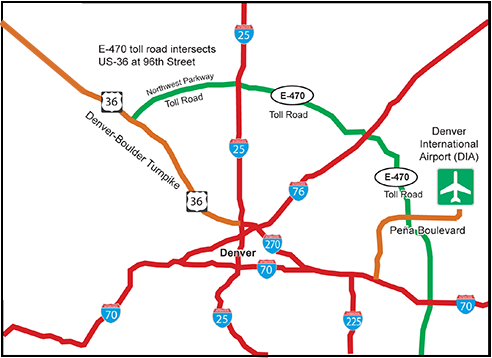
DIA to NOAA/SWPC, map image
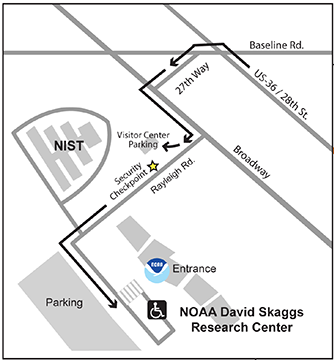
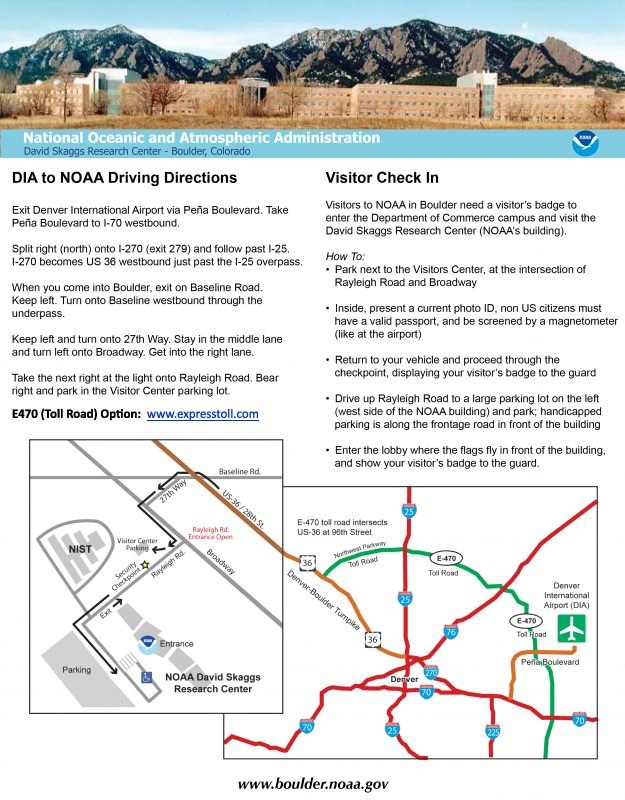
  1. Exit Denver International Airport via Peña Boulevard. Take Peña Boulevard to I-70 westbound.

  2. Split right (north) onto I-270 (exit 279) and follow past I-25. I-270 becomes US 36 westbound just past the I-25 overpass.

  3. When you come into Boulder, exit on Baseline Road. Keep left. Turn onto Baseline westbound through the underpass.

  4. Keep left and turn onto 27th Way. Stay in the middle lane and turn left onto Broadway. Get into the right lane.

  5. Take the next right at the light onto Rayleigh Road. Bear right and park in the Visitor Center parking lot.

325 Broadway, Boulder, CO

E470 (Toll Road) Option: www.expresstoll.com

Alternate Transportation from DIA

  • RTD SkyRide Bus Service: The AB1 bus line runs directly from DIA and stops at the 27th Way & Broadway station, which is located directly across the street from the NOAA campus entrance. (Note: The AB2 line serves a different route through northern Boulder at 28th/Canyon, so the AB1 is your best direct choice for NOAA).
  • Rideshare: Uber and Lyft operate freely between DIA and Boulder.
  • Airport Shuttles: Private or shared regional airport express shuttles are available by reservation.


Visiting SWPC

Visitors to NOAA in Boulder need a visitor's badge to enter the Department of Commerce campus and visit the David Skaggs Research Center (NOAA's building)

PLEASE NOTE:

Due to the volume of visitors arriving each morning, please plan to arrive 30 minutes early at the visitor center, as it takes some time to process each visitor.

If you are a foreign national and we have not yet reached out to you for information, please contact us immediately.

If you are a permanent resident/green card holder please be prepared to present your unexpired green card "Form I-551" at the visitor center on arrival.

Image
NOAA/SWPC, David Skaggs Research Center, visitor center map

Security Procedures for SWPC Visitors

  • Visitors are required to sign in and receive a visitor badge from the Visitors Center.
  • Visitors to the site who are U.S. citizens must present a U.S. photo ID, such as a current state driver's license.  Other accepted forms of ID are listed below.
  • Foreign Nationals must present a valid passport or a permanent resident ID ("green card") and will be subject to additional screening after registration.
  • All IDs must be originals only -- no photocopies accepted.
  • Effective July 21, 2014, under the REAL ID Act of 2005, federal agencies can only accept a state-issued driver's license or identification card for access to federal facilities if issued by states that are REAL ID compliant or have an extension. You can find more information on the Department of Homeland Security web site.

Other accepted forms of ID:

  • Passport
  • Passport card
  • DOD CAC card
  • Federal Agency HSPD-12 IDs
  • Veterans ID
  • Military ID
  • Military Dependents ID
  • Trusted Traveler card - Global Entry, SENTRI, or NEXUS
  • Transportation Workers Identification Credential (TWIC)

When you arrive:

  • Park next to the Visitors Center, at the intersection of Rayleigh Road and Broadway
  • Inside, present a current photo ID, non US citizens must have a valid passport, and be screened by a magnetometer (like at the airport)
  • Return to your vehicle and proceed through the checkpoint, displaying your visitor's badge to the guard
  • Drive up Rayleigh Road to a large parking lot on the left (west side of the NOAA building) and park; handicapped parking is along the frontage road in front of the building
  • Enter the lobby where the flags fly in front of the building, and show your visitor's badge to the guard.


Local Area Information

Boulder is at the base of the beautiful Rocky Mountains and offers stunning views of the famous Flatirons. The NOAA/SWPC campus is minutes from miles of hiking trails at Chautauqua Park, local dining at the Table Mesa Shopping Center, and the famous outdoor Pearl Street Mall.

Getting Around & Enjoying Boulder

2026 Bulk Electric System Testbed Exercise

Space Weather Prediction Testbed 2026
Bulk Electric System Exercise


Two 2.5-Day Participation Options - August 18-20 or August 25-27, 2026

The 2026 Space Weather Prediction Testbed Bulk Electric System (BES) Exercise will evaluate prototype decision-support services designed to improve how geomagnetic storm risk is communicated and applied in BES real-time operations. Through an operator-in-the-loop simulation, the exercise will assess whether modernized products provide actionable, user-driven, and risk-based information for preparedness, response, recovery, and all-clear decisions under operational uncertainty. The exercise will also examine how emerging scientific models, probabilistic forecasting techniques, and prototype applications can improve operational decision-making. Participant feedback will directly inform the development of next-generation space weather services that are aligned with real-world operational workflows.  

 
What this is
  • A displaced-real-time, operator-in-the-loop exercise simulating an impactful geomagnetic storm affecting the Bulk Electric System (BES) in the U.S. and Canada.
  • An evaluation of prototype SWPC decision-support services: revised geomagnetic storm communications and regionalized risk forecasts.
  • A test of whether modernized space weather services are understood without explanation and if they improve decision-making under time pressure.
Why it matters for grid operations
  • Operators need actionable information that fits real-time workflows for preparedness and response.
  • Industry feedback points to limitations in how geomagnetic-storm severity is communicated today, especially for extreme events and regional impacts.
What you get
  • A preview of prototype, BES-focused SWPC services, including interactive visualizations intended to support preparation, response, and recovery decisions.
  • A direct path to improve the tools you already use: input on timeliness, spatial specificity, product formats, and confidence cues so products integrate with common BES workflows.
  • Influence on next-generation services: actionable, user-driven, risk-based decision support rather than index-only reporting.
Who should participate
  • U.S. and Canadian Reliability Coordinators, Transmission Operators, Transmission Planners, Balancing Authorities, and GMD program leads.
  • Real-time operations leadership and analysts supporting storm response (situational awareness, operational planning, communications).
  • Partners with relevant measurements (e.g., geomagnetic field, GIC observations) where data-sharing constraints allow.
  • Researchers and developers whose ongoing work aligns with the exercise objectives outlined below.
What we will ask you to do
  • Work through a real-time simulation of a geomagnetic disturbance focusing on key decision points using the prototype space weather services.
  • Provide feedback on actionability: timing, clarity, and regional specificity.
  • Optionally share decision triggers and information needs to improve future services.
  • Share perspectives on how forecasting methods and scientific approaches could evolve to better address end-user operational needs and inform future research directions.
When and Where
  • Offered in two identical sessions:
    • Session 1: August 18–20, 2026
    • Session 2: August 25–27, 2026

      (Each session runs 2.5 days)

  • Hosted in person by the Space Weather Prediction Testbed at the NOAA Space Weather Prediction Center in Boulder, CO
Exercise Objectives
  • Storm Onset Timing
    Improve communication of geomagnetic storm onset using ensemble forecasting techniques with confidence intervals, including how forecast timing and confidence are updated as the storm approaches to better support user needs.
  • Probabilistic Intensity Forecasting
    Provide probabilistic forecasts of geomagnetic storm intensity.
  • Regional Hazard and Risk Guidance
    Provide regional geoelectric field hazard information and associated operational risk guidance, including the likelihood of exceeding user-driven impact thresholds at spatial scales relevant to user needs.
  • Unbounded Storm Intensity Scaling
    Explore options for moving from bounded Kp scaling to unbounded indices such as Hp for extreme-event characterization.
  • Storm Duration Forecasting
    Forecast storm duration and evolving conditions, including whether impacts are expected from a single event or multiple sequential CME arrivals.
  • Storm Lifecycle Characterization
    Characterize key phases of the geomagnetic storm lifecycle as they relate to Geomagnetic Disturbance (GMD) hazards, including shock arrival, storm main phase, substorm activity.
  • Storm Termination / All-Clear Guidance
    Develop formal all-clear guidance informed by user feedback and operational needs identified during the exercise.
  • Space Weather Product Integration into BES Tools
    Improve integration of space weather forecasts and geoelectric field estimates into BES operational and planning models.
How to get involved
  • This exercise is by invitation.
  • To express interest, please coordinate through the Space Weather Prediction Testbed Lead Hazel.Bain@noaa.gov
Media
Image
Testbed Exercise 2026 - Bulk Electric System

Experimental GloTEC

Comparison page for GloTEC animations

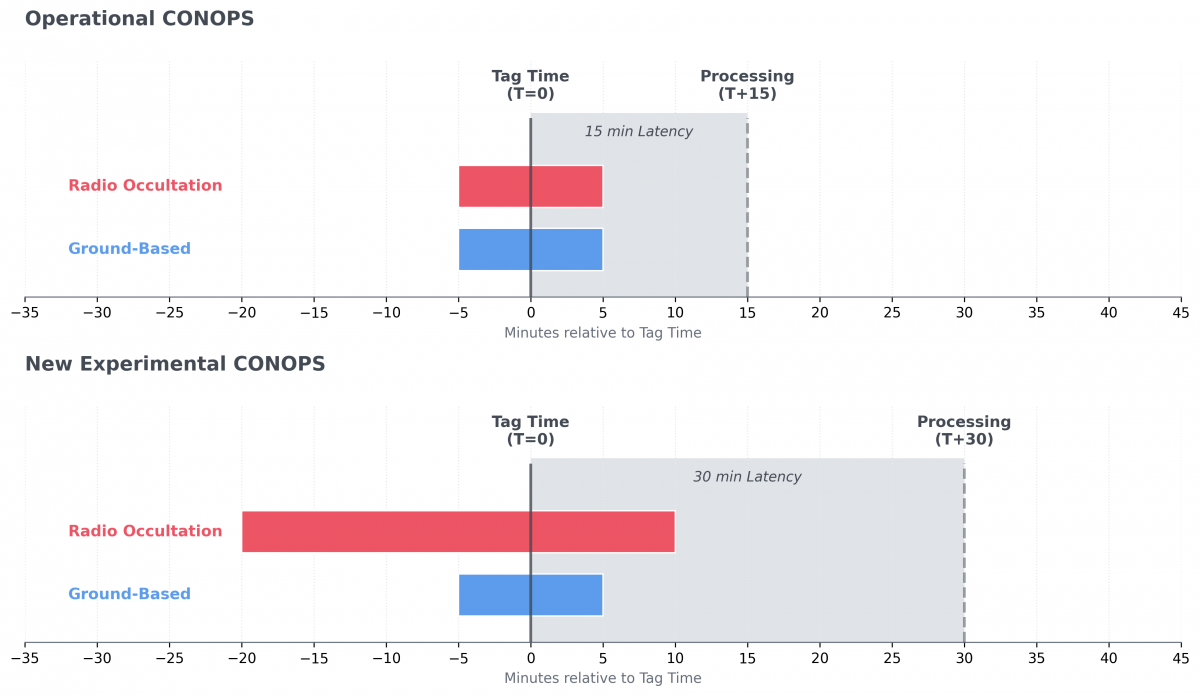
The current operational GloTEC CONOPS uses a 10-minute cadence, 15-minute latency, and a 10-minute observation window for both ground-based and RO observations, centered on the analysis tag time. The current operational CONOPS with 15-minute latency prevents the usage of most of the RO data due to the data latency. To improve model accuracy through ingesting more RO measurements, the new experimental CONOPS configuration shown on this page retains the 10-minute cadence but uses a 30-minute latency. Ground-based TEC is ingested over a 10-minute window, whereas RO data are ingested over an expanded 30-minute window extending from 20 minutes prior to 10 minutes after the analysis tag time. Two versions of the new experimental CONOPS are shown here. One version assimilates TEC data from ground-based receivers and COSMIC-2 radio occultation TEC data (left column). The other version uses the same ground-based and COSMIC-2 data, and adds the real-time PlanetiQ radio occultation TEC data acquired through NOAA’s Commercial Data Program (right column). The PlanetiQ RO data comes from the satellites GNOMES-4 and GNOMES-5. Both satellites are in sun-synchronous orbit. GNOMES-4 orbits at 10LT and 22LT. GNOMES-5 orbits at 11LT and 23 LT. PlanetiQ data provides polar coverage in these specific local time sectors.


Contact tzu-wei.fang@noaa.gov with questions or feedback

Image
New experimental CONOPS

2025 GNSS User Engagement

A GNSS User Engagement will be hosted by NOAA SWPC between 9 am and 12:30 pm on May 21st, 2025. Virtual or in-person participation is welcome. More details will be provided here. Please contact Tzu-Wei Fang (tzu-wei.fang@noaa.gov) if you have any questions. 

During the GNSS User Engagement session, the NOAA Space Weather Prediction Center (SWPC) will:

  • Provide information on space weather impacts on GNSS Positioning, Navigation, and Timing (PNT)

  • Present the latest ionospheric products and developments

  • Discuss strategies for integrating these products into GNSS solutions to mitigate space weather-related risks

This session will serve as a platform to exchange valuable insights and forge partnerships aimed at strengthening the entire PNT ecosystem against space weather challenges. Your expertise and leadership in the GNSS sector are invaluable, and we would be honored by your participation. We encourage you to join us in person if possible, and we would greatly appreciate a short (10-minute) presentation on:

  • Real-world scenarios in which space weather events have disrupted the accuracy, reliability, or continuity of GNSS-based systems

  • Future ionospheric products or enhancements that would be beneficial to your operations

Agenda

0900 - 0905 Introduction – Tzu-Wei Fang (NOAA/SWPC)

0905 - 0915 Ionosphere 101 including WAM-IPE – Tim Fuller-Rowell (NOAA/SWPC)

0915 - 0930 Global Real-Time TEC Product from NOAA SWPC – Dominic Fuller-Rowell (NOAA/SWPC)

0930 - 0945 Future Scintillation Product – Tibor Durgonics (NOAA/SWPC)

0945 - 1000 May 2024 Storm Impact on GNSS on the Ground and in Space – Jade Morton (CU Boulder)

1000 - 1015 Space Weather Impact on the Wide Area Augmentation System – Bill Wanner (WAAS) 

1015 - 1030 Space Weather Events Impacts on Tropical Precision Agriculture – Edmundo Beinecke (John Deere) 

1030 - 1045 Impact of ionospheric activity on (Septentrio) GNSS receivers – Yasmine Hunter (Septentrio)

1045 - 1100 Regional fits of Klobuchar coefficients to TEC maps: a pragmatic approach to improve smartphone positioning error – Sean Gorman (Zephr)

1100 - 1115 EarthScope GNSS and Space Weather – David Mencin (EarthScope)

1115 - 1130 Space Weather Impacts on Agricultural Uses of GNSS: Estimation of Losses due to Signal Degradation and Valuation of Duration Forecast – Terry Griffin (Kansas State University)

1130 - 1230 Open discussion

GOES SUVI Flare Location Product

GOES Solar Ultraviolet Imager (SUVI) Automated Flare Location Product

The GOES Solar Ultraviolet Imager (SUVI) Flare Location Product reports the latest solar flare location for SUVI’s “flaring” spectral channels (94Å and 131Å) in Heliographic Stonyhurst coordinates.

Do you have feedback about this product? Provide it here.

The GOES Solar Ultraviolet Imager (SUVI) is NOAA's operational solar extreme-ultraviolet (EUV) imager. This telescope allows forecasters to monitor the Sun’s hot outer atmosphere, or corona. Observations of solar EUV emission aids in the early detection of solar flares, coronal mass ejections (CMEs), and other phenomena that impact the geospace environment.

The real time SUVI flare location product reports flare locations for the SUVI “flaring” spectral channels (94Å and 131Å) with a 4 minute cadence. Graphical products show flare locations in the Heliographic Stonyhurst coordinate system for the most recent flare location. The SUVI Flare Location JSON data service also includes the flare location in R-theta, and pixel coordinate systems.

The SUVI Flare Locations are determined from the SUVI Thematic Map and, for each distinct flaring region, the algorithm returns the intensity-weighted centroid that indicates the location of each flare. Locations when the GOES X-ray Sensor (XRS) Event Detection algorithm determines that a solar flare is in progress.

For further details, see the following links: 

NOAA NCEI archive of GOES Products and additional documentation

Example Jupyter Notebooks to Plot SUVI Flare Locations

Journal Article on Thematic Map Approach

2025 Artemis-II Human Spaceflight Support Exercise Information


Overview

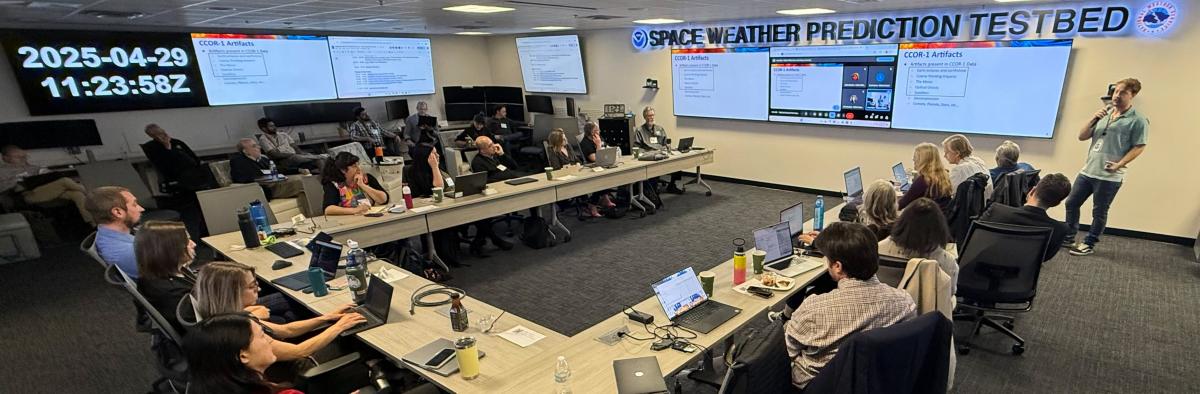
The Space Weather Prediction Testbed (SWPT) is pleased to announce an upcoming Space Weather Testbed Exercise in support of Human Space Exploration and the Artemis-II Mission. The exercise aims to strengthen collaboration among the NOAA Space Weather Prediction Center (SWPC), NASA’s Space Radiation Analysis Group (SRAG) and Moon to Mars Space Weather Analysis Office (M2M), the Department of Defense (DoD), commercial industry experts, and the academic research community. Together we will work to enhance preparedness for human space flight endeavors. 

While the exercise will primarily focus on supporting the Artemis II Mission, it will also provide critical insights and advancements for broader human space flight missions. Participants will be able to explore and evaluate new space weather products and applications, contributing to the research-to-operations-to-research (R2O2R) transition process. 

The exercise will focus on three major objectives:

(1) an evaluation of the University of Málaga Solar Particle Event Predictor (UMASEP) model for real-time solar energetic particle (SEP) forecasting in support of SWPC’s proton Warning and Alert products. 

(2) a demonstration of new Geostationary Operational Environmental Satellite (GOES) space weather products including: an automated flare location product from the GOES Solar Ultraviolet Imager (SUVI); heavy ion measurements from the GOES Energetic Heavy Ion Sensor (EHIS); and alpha particle observations from the GOES Solar and Galactic Proton Sensor (SGPS).

(3) the simulation of a solar radiation storm to exercise the roles of NOAA SWPC forecasters, NASA Space Radiation Analysis Group (SRAG) console operators, and NASA Moon-to-Mars (M2M) analysts during the upcoming Artemis II Mission.

During the exercise, small groups of participants will collaboratively work through a simulated radiation storm scenario and evaluate space weather products. Each group will consist of a SWPC forecaster, a SRAG console operator, and a M2M analyst, alongside a mix of researchers and developers from academia, industry, and DoD who are developing relevant models and applications and/or involved with human space flight related operations.

The exercise will be conducted as follows

  • Duration: Each exercise will span 2.5 days
  • Dates: The exercise will be repeated over consecutive weeks to maximize engagement:
    • Week 1: April 29th to May 1st, 2025
    • Week 2: May 6th to May 8th, 2025
  • Format: The exercises will be conducted in person.
  • Location: Space Weather Prediction Center (SWPC) in Boulder, Colorado.

Agenda


Specific goals we want from the exercise:

  • Building new and strengthening existing relationships with our core partners (SRAG, M2M, CCMC, DoD, research/academia, commercial industry, etc.) to achieve a common understanding of operational needs and capabilities that can be provided by research and development
  • Determine the ability to improve forecast timeliness and confidence of SEP event threshold crossing via evaluation of the UMASEP model, a new SUVI flare location product, GOES EHIS heavy ion and SGPS Alpha particle data, and other new capabilities that we want to transfer to operations and release to users
  • Obtain a clearer understanding of how SWPC, SRAG, M2M and the DoD (ex. - 45th Weather Squadron) work together during Artemis-II mission support, and the role of the SWPC forecaster when embedded with SRAG
  • Test SWPC internal practices and how SWPC can improve coordination with space environment partners to better understand their threshold requirements, and identify mechanisms to support those requirements
  • Showcase the ability to perform displaced real-time Space Weather Prediction Testbed exercises to improve the R2O2R process

How we plan to achieve those goals:

  • In-person interagency participation at each forecast desk within the Space Weather Prediction Testbed to foster communication and understanding amongst participants, including blending operations and research to foster O2R feedback
  • Displaced real-time demonstration of UMASEP and other capabilities using a number of diverse space weather events
  • Simple centralized location to gather anonymous feedback continuously (via web portal)
  • In-depth daily debriefs on product performance and decision making processes
  • Presentations from participating partners and researchers

A glossary of terms that we will be using during the exercise can be found here.

Image
DIA-to-DSRC Map Image from 20140710

Local information (hotels, restaurants, things to do):  https://www.bouldercoloradousa.com/

  • Hotel Information:
    • Week 1: There is a block of rooms available at the Fairfield Inn & Suites. Register using the following link. The block of rooms is available to register until April 14th, but there should still be some availability after that if needed.
    • Week 2: There is a block of rooms available at the Hampton Inn & Suites. Register using the following link. The block of rooms is available to register until April 11th. NOTE: May 8th is University of Colorado’s commencement, so hotel availability is limited.  We recommend booking sooner than later.


Page Type
Banner
Image
SWPC Testbed Event for Artemis II Support Image for 20250429
Status
Thumbnail
Image
SWPC Testbed Event for Artemis II Support Image for 20250429